“This is where BAO’s second missionary journey must be more deliberate than the first. Ekiti cannot afford to be an island of good governance in a sea of federal projects. The real test of this second term is how well he taps from the Renewed Hope at the centre”
OF GOV OYEBANJI AND HIS SECOND MISSIONARY JOURNEY
By Segun Dipe
In the Acts of the Apostles, Paul’s second missionary journey was not as noisy as the first. The first was about breaking ground, proving a point, surviving stonings at Lystra. The second was about strengthening the churches already established, confirming the souls of the disciples, and building systems that would outlive the apostle.
That is the parable of Biodun Abayomi Oyebanji in Ekiti today.
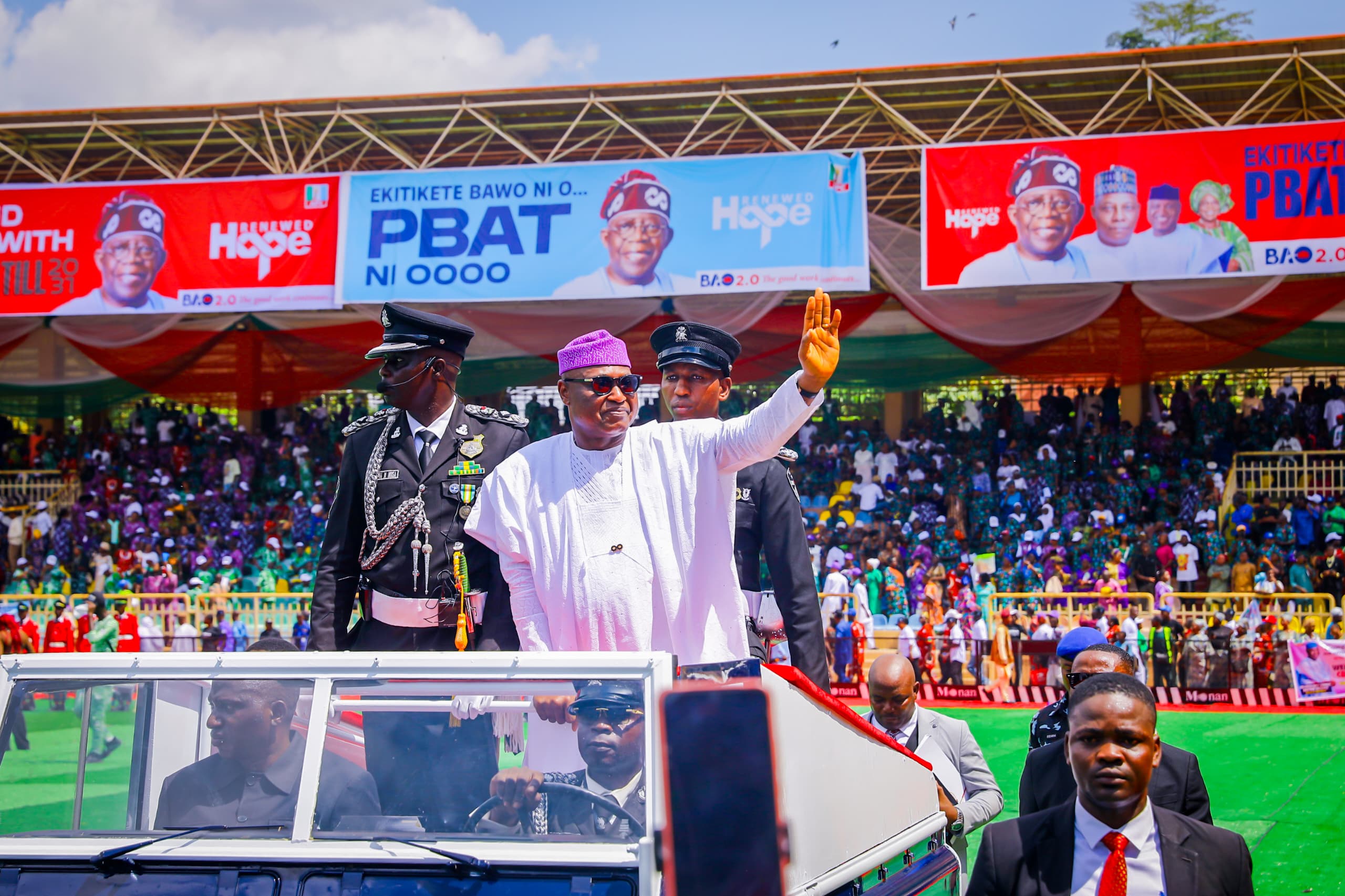
On October 16, 2026, at the Ekiti Parapo Pavilion, history quietly corrected itself. For the first time since 1999, an incumbent governor in Ekiti broke the jinx. Ekiti, the state famous for voting out incumbents, chose continuity over uncertainty. That alone is a sermon. The election has come and gone. The ballot boxes have been kept. What matters now is not who voted where, but what we do with the peace the ballot has given us.
If the first term was about proving that governance can be kind, this second term must be about proving that kindness can unite and be productive.

Let us be honest. BAO’s first missionary journey was not glamorous, but it was necessary. He inherited arrears and paid them. Five months of salary arrears cleared, seven months of deductions paid, ₦36.6 billion in pensions and gratuities paid to 10,093 pensioners between October 2022 and August 2026, ₦70,000 minimum wage implemented when others were still negotiating. He recruited 6,000 teachers, renovated 203 secondary schools and over 950 primary schools, equipped them with ICT labs, paid WASSCE fees for 69,000 students. In health, 110 primary healthcare centres renovated, over 800,000 free health services delivered, neonatal mortality cut from 42 to 18 per 1,000 live births. In infrastructure, over 500 kilometres of roads, plus 132 kilometres of rural roads under RAAMP. Electricity restored to Ayekire, Ekiti East and Ikogosi corridor after years of darkness. And that dream many mocked — the Ekiti Agro-Allied International Cargo Airport — began commercial operations in late 2025.
Internally Generated Revenue moved from ₦8.7 billion in 2022 to ₦27.1 billion in 2025. GDP is projected from ₦2.4 trillion to near ₦8.8 trillion in 2026. These are not figures for PowerPoint; they are signs that the civil service state is learning to become a productive state.
But the real beauty of this victory is not in the numbers. It is in the olive branch.
In his inauguration speech, BAO did not gloat. He extended a hand to all — to those who contested, to those who stayed away, to those who abused him on radio, to those who ran to Abuja to stop him. He said Ekiti is bigger than any party, and his government will be big enough to accommodate all. That is not politics; that is pastoral wisdom. Ekiti is too small to be divided. After election, governance must replace grievance.
This olive branch is strategic. Ekiti cannot go into the future with a house divided against itself.
And this is where BAO’s second missionary journey must be more deliberate than the first. Ekiti cannot afford to be an island of good governance in a sea of federal projects. The real test of this second term is how well he taps from the Renewed Hope at the centre.
President Bola Ahmed Tinubu’s Renewed Hope Agenda — food security, MSME industrialisation, CNG transport, student loans, social investment — was designed for sub-nationals who are ready. BAO domesticated it early into his six-pillar agenda. Now he must go beyond alignment to extraction.
Ekiti has a cargo airport that needs federal certification for 24-hour operations. It has an Ekiti Knowledge Zone that needs NITDA and Bank of Industry funding. It has farm clusters that need Anchor Borrowers 2.0, livestock that needs federal abattoir grants, and roads that need to be linked to the federal corridor. The presence of Vice President Kashim Shettima at his inauguration was not ceremonial. It was a signal that the centre is watching Ekiti.

But here is the deeper message BAO is quietly preaching across the 16 local governments: in 2027, Ekiti must not vote along party lines. Ekiti must vote as Ekiti. For President Tinubu.
He is telling PDP elders, ADC youths, LP supporters, and even the aggrieved within APC, that the presidential election is not a party contest; it is an Ekiti interest. That Ekiti’s road to Aso Rock is not through party registers, but through a united Ekiti voting bloc that tells Abuja, “We are with our own, and we are with the man who has kept his promise to us.” That is how you get federal attention. That is how you turn a small state with no oil into a state that cannot be ignored.
The currency of federal attention is not lamentation; it is loyalty expressed through votes. And BAO, who served as Secretary to the State Government in 2011 and Political Adviser in 2003, knows how to mobilise beyond party lines. His politics has never been about APC versus PDP; it has been about Ekiti versus neglect.
What then are the quick wins that will make the people feel this second journey from day one?
First, light up the remaining dark spots. Complete the Independent Power Project at Ikogosi and extend it to industrial clusters so welders, tailors, barbers and cold-room operators can feel cheap power before Christmas.
Second, roll out the CNG buses already promised. Ten CNG buses on Ado routes and five on inter-LGA routes will cut fares by half and prove that subsidy removal has a human face.
Third, activate the cargo airport for agro-export. Even if it is one flight a week carrying cocoa, yam flour and palm oil, let farmers see that the runway is not for decoration.
Fourth, launch the Ekiti MSME Fund — small, collateral-free loans for artisans, with 48-hour approval. When a vulcanizer in Ise gets ₦200,000 to buy new equipment, Renewed Hope stops being a slogan.
Fifth, flag off Ado Ring Road Phase 2 and the Ikere-Igbara-Odo Road that links Ekiti to Ondo’s port corridor. People need to see shovels in the ground in the first 100 days.
Ekiti at 30 provides a bigger canvas. BAO has unveiled a 30-year Transformation Agenda to move Ekiti from civil service tag to Tech Hub, agro-processing and creative economy hub. It is ambitious. But ambition is cheaper than failure.
The soft-landing Ekiti people have given him — no violent transition, no bitter handover, no court drama — must not be mistaken for a blank cheque. It is a demand for deeper impact, broader inclusion, and strategic alignment with the centre.
BAO’s second missionary journey has started on a note of grace. He has the goodwill of traditional rulers, the loyalty of workers, the confidence of investors who now see an airport, and the patience of a people who broke their own jinx to keep him.
He must now use that goodwill to heal the land, to negotiate with Abuja, and to build an Ekiti where, when the President’s name is mentioned, party caps are removed and Ekiti caps are worn.
The churches have been planted. Now, let them be strengthened. And let the collection from the centre reach the pews in Ekiti.
* Segun Dipe writes from Ado-Ekiti.