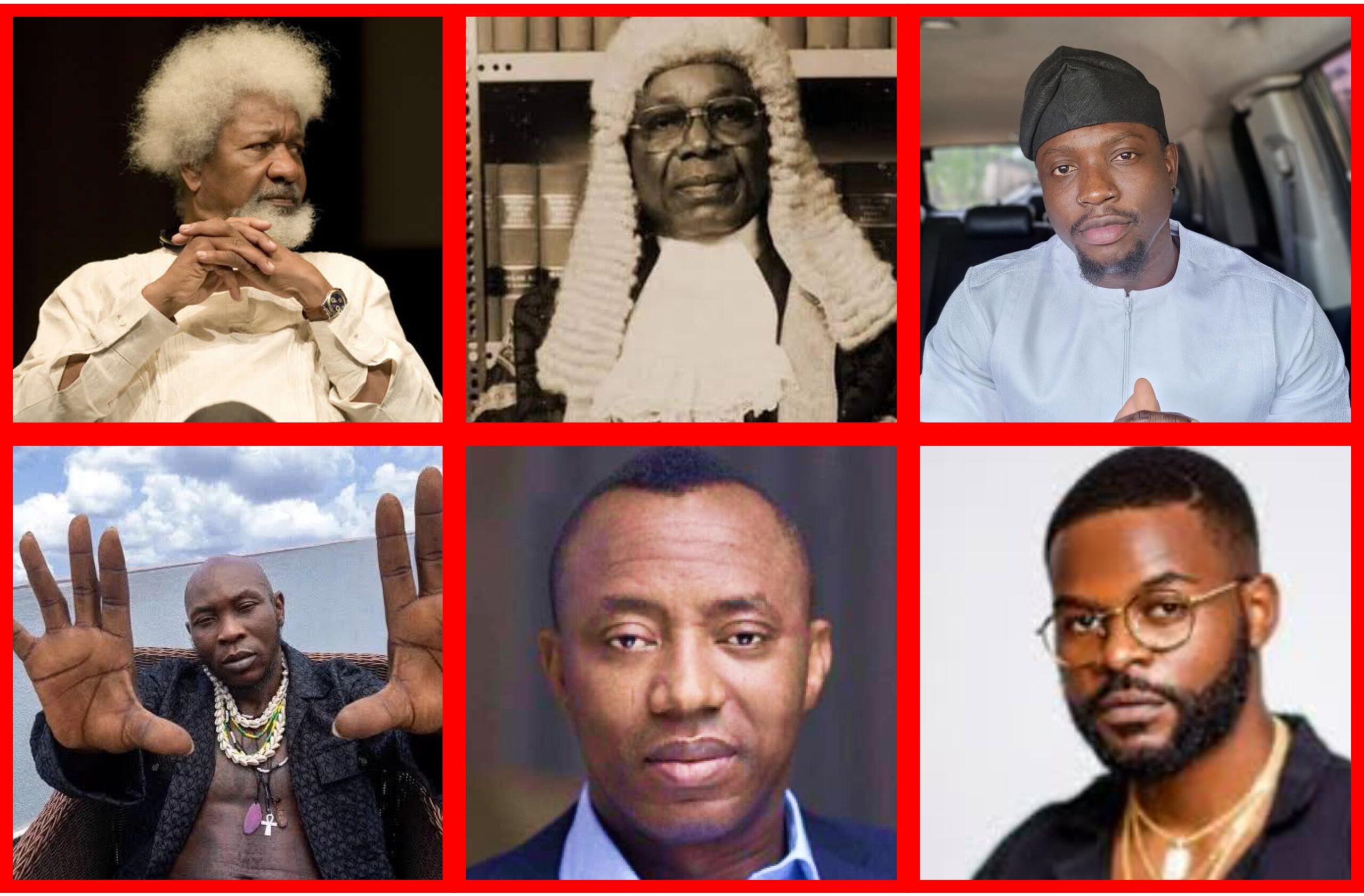
“Wole Soyinka wielded the power of the pen, the stage and the moral imagination. Gani Fawehinmi transformed the courtroom into a battlefield for justice and constitutionalism. Tai Solarin challenged authority with uncommon courage and lived the values he preached”
From Soyinka to VeryDarkMan: The Changing Face of Dissent in Nigeria
By Babafemi Ojudu
Love him or loathe him, VeryDarkMan (VDM) has become one of the most talked-about public figures in Nigeria today.
His videos ignite fierce debates. His methods offend some and inspire others. His critics accuse him of sensationalism; his admirers hail him as a fearless defender of the ordinary Nigerian. Yet beyond the arguments over his style lies a far more important question:
Why has one young man, armed with nothing more than a smartphone, become one of the loudest voices demanding accountability in a nation of over 200 million people?
The answer says less about VeryDarkMan than it does about Nigeria.
It speaks to a country where many of the institutions and personalities that once challenged power have grown quieter, weaker, or more accommodating. It reveals a vacuum in public life—a vacuum into which a new generation of dissenters has inevitably stepped.
VeryDarkMan did not create that vacuum. He simply occupies it.
There was a time in Nigeria when the ordinary citizen was never left to confront power alone.
There was always someone standing at the barricades.
Wole Soyinka wielded the power of the pen, the stage and the moral imagination. Gani Fawehinmi transformed the courtroom into a battlefield for justice and constitutionalism. Tai Solarin challenged authority with uncommon courage and lived the values he preached. Alao Aka-Bashorun, Kanmi Ishola Osobu and Femi Falana transformed the legal profession into a formidable platform for defending democracy and the rule of law. Justices Akinola Aguda, Chukwudifu Oputa, Kayode Esho and several others formed an informal tradition of judicial activism, delivering courageous and progressive judgments from the bench. Meanwhile, Beko Ransome-Kuti mobilised the medical profession in the service of freedom and human rights.
The press was truly the Fourth Estate. Newspapers investigated, questioned and unsettled those in authority. Ayodele Awojobi confronted incompetence wherever he found it. Obafemi Awolowo’s interventions carried such moral weight that governments ignored them at their peril. Every week, Fela Anikulapo-Kuti used music to ridicule corruption and expose the absurdities of military rule. In the North, Balarabe Musa remained a relentless voice against feudal politics and authoritarianism.
On the campuses, student leaders—including young activists such as Omoyele Sowore—were not merely advocates for better hostels or cheaper meals; they were the conscience of the nation. The labour movement did not issue empty threats; it organised, mobilised and acted. Intellectuals such as Edwin Madunagu, Segun Osoba, Biodun Jeyifo, Bala Usman and Jibo Ibrahim supplied the scholarship and ideological clarity that exposed the systematic plunder of Nigeria and challenged the myths used to justify oppression. Even within the military—yes, the military—officers like Colonel Abubakar Dangiwa Umar and a handful of others defied convention and risked everything to stand on the side of democracy.
It was not a perfect era. Governments were often repressive. Activists were harassed, detained and, in some cases, killed. Yet power always knew that someone was watching, someone was questioning, someone was prepared to resist.
The people were never entirely abandoned.
Today, much of that ecosystem of organised dissent has withered.
Many institutions that once challenged power now seek accommodation with it. Sections of the media have become timid or transactional. Civil society is fragmented. Labour often hesitates or compromises. Student unionism has lost much of its national influence. Too many intellectuals have retreated into consultancy, partisan comfort or silence.
The consequence is that public anger often finds no organised expression.
Into that vacuum has stepped VeryDarkMan.
Whether one admires him or dislikes him is, in many respects, beside the point.
Like many disruptive figures before him, he provokes strong emotions. His methods are unconventional. His language is often abrasive. His interventions can be impulsive and controversial. Yet it is difficult to deny that he has succeeded in doing what many established institutions have failed to do: he has captured the attention of millions of young Nigerians and channelled their frustrations into national conversations about injustice, abuse of power, corruption and accountability.
History teaches us that every generation produces its own dissenters.
They rarely look alike.
They do not speak the same language or employ the same methods.
Fela was not Gani.
Gani was not Soyinka.
Soyinka was not Beko.
None resembled Tai Solarin.
Each reflected the realities, technologies and political circumstances of his own time.
VeryDarkMan belongs to a different era.
His stage is no longer the university campus or the courtroom.
It is the smartphone.
His audience is not limited to those who buy newspapers or attend rallies. It numbers in the millions across social media.
The smartphone has become the printing press, the courtroom, the concert stage and the public square of the twenty-first century. In many ways, VeryDarkMan is a product of that digital revolution.
But if he is to become more than a social media phenomenon, he must continue to evolve.
Passion alone is not enough.
Moral courage must be matched with intellectual depth. Popularity must be anchored in knowledge. Outrage must mature into organisation. Consistency, discipline, historical understanding and a deeper appreciation of institutions will determine whether he becomes merely a viral sensation or a lasting force in Nigeria’s democratic journey.
The same challenge confronts every young activist.
History remembers those who built institutions, not merely those who dominated headlines.
Which brings me to a final appeal.
VeryDarkMan, Omoyele Sowore, Seun Kuti and Falz—whose voice became one of the defining sounds of the #EndSARS movement—despite your different temperaments, methods and constituencies, are all responding, in one way or another, to the frustrations of the same generation.
The disagreements among you may generate headlines, but they do little to advance the cause of national renewal.
Nigeria is too fragile, and its challenges too profound, for those who seek change to dissipate their energies fighting one another.
History remembers movements more than individuals.
It remembers coalitions more than egos.
Find common ground where you can. Respect your differences where you must. Build trust. Develop a strategy. Organise beyond social media. Mobilise young Nigerians around ideas rather than personalities. Give the nation a coherent vision and a disciplined programme of action.
The faces of dissent will always change.
Yesterday, they were Soyinka, Gani, Beko, Tai Solarin, Fela and Balarabe Musa.
Today, among others, they include VeryDarkMan, Sowore, Seun Kuti and Falz.
Tomorrow, they will be others still.
But one truth remains constant.
Every generation must produce men and women who are willing to stand at the barricades and remind those who wield power that Nigeria does not belong to governments, political parties or powerful interests.
It belongs to the people.
And so long as injustice endures, the nation will continue to need its dissenters.